
Composite NDT Training & Cert. Programs

A highly skilled wind turbine technician takes in the view from the nacelle of a turbine during a maintenance check. This perspective highlights the scale and importance of proper training in wind power NDT during our transition to sustainable energy.
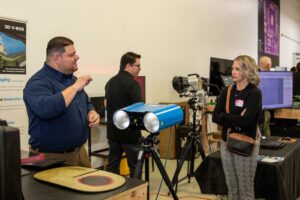
A Level III NDT specialist showcases the Voidsy 3D V-ROX Photothermal Tomography system at the AIMM Center in Ogden Utah on April 4, 2025.
Specialized Inspection Training for Aerospace, Wind Energy, and Advanced Composite Structures
The transition from metals to advanced composites demands a fundamental shift in inspection methodology. Carbon fiber reinforced polymers (CFRP), glass fiber laminates (GFRP), and sandwich constructions behave nothing like the isotropic materials most NDT technicians trained on. Sound doesn’t travel straight. Defects hide in ways they never could in aluminum. And the stakes—whether it’s an aircraft fuselage or a 100-meter wind turbine blade—couldn’t be higher.
CICNDT delivers composite-specific NDT training built on 40+ years of ultrasonic science experience and active field work across aerospace and renewable energy sectors. Our instructors hold Level III certifications under NAS 410, ISO 9712, and SNT-TC-1A. They’ve inspected SpaceX structures, developed procedures for Siemens Gamesa and GE Renewables, and understand the gap between textbook theory and production floor reality.
For detailed training information, contact CICNDT via info@cicndt.com
—
Why Composite Inspection Requires Specialized Training
Technicians certified in conventional ultrasonic testing often struggle when they encounter their first composite structure. The physics change fundamentally.
In CFRP, acoustic velocity parallel to the fibers can reach 9,000 m/s while velocity perpendicular to the plies drops to around 3,000 m/s. This anisotropy creates beam steering effects that cause sound energy to deviate from expected paths. A technician trained only on steel calibration blocks will misinterpret these phenomena as defects—or worse, miss actual discontinuities entirely.
Sandwich constructions present an additional challenge. When a dense composite skin meets a low-density foam or honeycomb core, the acoustic impedance mismatch can reflect nearly 100% of ultrasonic energy at the bond line. Standard pulse-echo techniques simply cannot penetrate to inspect core integrity. This physical reality drives the need for alternative approaches: low-frequency methods, pitch-catch configurations, and bond testing modes that measure stiffness and damping rather than sound transmission.
Our curriculum addresses these realities directly. Students learn not just how to operate equipment, but why composite materials behave the way they do—and how to adapt their inspection strategy accordingly.
Training Programs
NDT of Composites: Foundation Course
Duration: 24-40 hours (configurable to client requirements)
Prerequisites: Basic UT knowledge recommended; not required
Standards Alignment: Contributes toward NAS 410, ISO 9712, SNT-TC-1A certification hours
This course establishes the material science foundation that separates competent composite inspectors from those who simply follow procedures without understanding.
Curriculum includes:
Material Science and Fabrication Methods — Understanding how defects originate requires understanding how composites are made. We cover pre-preg layup, resin infusion (VARTM, RTM), filament winding, and autoclave curing. Students learn why porosity forms during cure cycles, how dry spots develop when resin flow is impeded, and what causes fiber waviness in thick laminates.
Physics of Wave Propagation in Heterogeneous Media — Detailed treatment of attenuation mechanisms, scattering at fiber/matrix interfaces, and the acoustic impedance relationships that govern inspection of sandwich structures. Students calculate reflection coefficients and predict where conventional UT will fail.
Defect Recognition and Terminology — Aligned with ASTM E2533, this module standardizes how students identify, describe, and report discontinuities. We distinguish between manufacturing defects (porosity, foreign object debris, resin-starved areas, wrinkles) and service-induced damage (impact damage, fatigue delamination, fluid ingress, lightning strike effects). Particular emphasis on BVID—Barely Visible Impact Damage—where extensive internal delamination occurs with minimal surface indication.
Conventional Ultrasonic Techniques for Composites — Hands-on application of pulse-echo and through-transmission methods using frequencies appropriate for the material (typically 0.5-2.25 MHz for thick GFRP, up to 5-10 MHz for thin aerospace laminates). Students learn to interpret back-wall echo loss, recognize porosity signatures, and size delaminations using amplitude and time-of-flight data.
Laboratory Sessions — Students inspect actual composite specimens containing natural and manufactured defects—not just machined flat-bottom holes. Wind blade sections, aerospace panel samples, and sandwich constructions with disbonds provide realistic inspection challenges.
—
Bond Testing: Inspection of Sandwich Structures and Adhesive Joints
Duration: 16-24 hours
Prerequisites: Foundation course or equivalent experience
Standards Alignment: NAS 410, SNT-TC-1A (Bond Testing method)
When conventional ultrasonics cannot penetrate past the first bond line, inspectors need alternative physics. This course delivers comprehensive training on bond testing principles and equipment operation.
The Three Primary Modes:
Pitch-Catch — Uses dual-element probes with separate transmit and receive tips. In a properly bonded structure, acoustic energy transfers efficiently between tips through the skin-core interface. Disbonds attenuate transmission and alter wave modes. This technique excels for honeycomb structures and thick cores where through-transmission isn’t practical. No couplant required for many probe configurations.
Mechanical Impedance Analysis (MIA) — A contact method measuring the mechanical stiffness and damping of the structure. The probe vibrates the surface at frequencies between 2-50 kHz; bonded areas resist vibration differently than disbonded regions. MIA detects crushed core, skin-to-core separation, and near-surface disbonds. Particularly valuable for rapid scanning of large composite surfaces.
Resonance — Narrowband ultrasonic excitation (typically 35-350 kHz) drives the part at its resonant frequency. Disbonds and thickness variations shift the resonance point, appearing as phase and amplitude changes on the instrument display. Excellent sensitivity for thin-skinned laminates and metal-to-composite bonds.
Operational Mastery — Beyond theory, students develop the hands-on skills that determine probability of detection: proper probe pressure and orientation, calibration on representative reference standards, interpretation of phase-amplitude plane displays, and documentation practices that satisfy quality requirements.
Equipment: Training conducted on current-generation bond testing instruments. Students gain proficiency applicable across equipment platforms, not just single-manufacturer systems.
—
Advanced Composite Inspection: Phased Array and Imaging Methods
Duration: 24-40 hours
Prerequisites: Foundation course; conventional UT proficiency
Standards Alignment: NAS 410 Level II/III, ISO 9712
Advanced applications demand advanced tools. This course covers the imaging and analysis techniques required for complex geometries, quantitative defect sizing, and engineering disposition support.
Phased Array Ultrasonic Testing (PAUT) for Composites — Electronic beam steering and focusing enable inspection of curved surfaces, tapered sections, and radius transitions that defeat conventional single-element probes. Students learn sectorial scanning, linear scanning, and the generation of S-scans and C-scans for comprehensive coverage documentation. Critical differences from metals PAUT are emphasized: lower frequency requirements, anisotropic velocity corrections, and specialized probe selection for composite applications.
Full Matrix Capture and Total Focusing Method (FMC/TFM) — The most advanced acquisition mode available on current phased array platforms. FMC records the complete set of transmit-receive combinations, providing maximum acoustic information. TFM post-processing synthetically focuses at every pixel in the image, delivering optimal resolution throughout the inspection volume. Students learn when FMC/TFM provides genuine advantage over conventional PAUT and when simpler approaches suffice.
Infrared Thermography — Non-contact, rapid area coverage for detecting water ingress, near-surface delaminations, and heat-generating defects. Active flash thermography principles, thermal diffusivity effects in anisotropic materials, and interpretation of thermal decay curves. Particularly effective for honeycomb water detection and large-area screening.
Laser Shearography Awareness — Interferometric measurement of surface strain under applied stress. Shearography detects disbonds, delaminations, and—critically—kissing bonds that transmit ultrasound but lack structural strength. While full shearography certification requires dedicated courses, this module provides the understanding necessary to specify shearography when other methods prove inadequate.
Industry-Specific Applications
Aerospace Composite Inspection

A sleek business jet parked on a rainy tarmac, symbolizing CICNDT’s commitment to aviation safety and reliability through advanced NDT services.
Aircraft structures demand the highest resolution and strictest procedural compliance. Our aerospace modules address CFRP fuselage and wing skins, honeycomb control surfaces (rudders, elevators, ailerons, flaps), nacelle structures, and flight-critical bonded joints. Training aligns with NAS 410 requirements and prepares technicians for work on Boeing 787, Airbus A350, and similar composite-intensive platforms.
Wind Turbine Blade Inspection

Blades exceeding 100 meters present unique challenges: massive scale, thick GFRP laminates (spar caps often exceed 40mm), balsa and foam cores, and adhesive bond lines between shell halves. Our wind energy curriculum addresses spar cap delamination detection using low-frequency techniques, trailing edge bond inspection, shear web attachment verification, and lightning damage assessment. Training reflects procedures developed through direct OEM relationships with major turbine manufacturers.
Certification Standards Alignment
Our training programs are structured to satisfy the hourly requirements of major personnel certification standards:
NAS 410 / EN 4179 — The aerospace industry standard for personnel qualification. NAS 410 Rev. 5 (2020) specifies minimum training hours by method and level. Our courses are designed to fulfill or exceed these requirements, with documentation suitable for inclusion in employer certification records.
ISO 9712:2021 — The international third-party certification standard. ISO 9712 mandates minimum 40% practical training content—a threshold all CICNDT courses exceed. Training supports qualification through ASNT’s new ASNT 9712 Certification Program.
SNT-TC-1A (2024 Edition) — The employer-based recommended practice used throughout U.S. industry. Course content and documentation align with Written Practice requirements for composite-specific method qualifications.
ASTM Standards — Inspection techniques taught align with current ASTM standards including E2580-24 (Ultrasonic Testing of Flat Panel Composites and Sandwich Core Materials) and E2533-21 (Guide for Nondestructive Testing of Polymer Matrix Composites).
—
Your Instructors
CICNDT instructors aren’t academics who learned composites from textbooks. They’re working Level III inspectors who’ve developed OEM procedures, supported production facilities, and solved inspection problems that didn’t have established solutions.
Our team holds certifications under PCN, ASNT, and EN 4179 across multiple methods. Combined, they bring over four decades of ultrasonic science expertise with specific depth in composite materials. They’ve trained technicians who now inspect structures for SpaceX, supported wind blade manufacturers on three continents, and developed the inspection protocols used at major aerospace production facilities.
This experience translates directly into training that addresses real-world challenges—equipment quirks, material variations, time pressure, and the judgment calls that separate adequate inspection from thorough inspection.
—
Training Facilities and Equipment
Training is conducted at CICNDT’s facility in Ogden, Utah, home to the newly established AIMM Center featuring advanced inspection technology including collaborative robot (cobot) scanning systems. Students gain hands-on experience with current-generation equipment:
- Phased array instruments with FMC/TFM capability
- Bond testing systems covering all three primary modes
- Portable and automated ultrasonic platforms
- Thermography systems for large-area inspection
- Reference standards and specimen libraries representing aerospace and wind energy applications
For clients requiring on-site training, CICNDT deploys complete training packages to your facility, using your equipment and your production samples when appropriate.
—
Custom Training and Systems Management
Standard courses address common requirements, but many organizations need tailored solutions.
Procedure-Specific Training — Your technicians learn to execute your procedures on your parts, not generic samples. Training integrates directly with your quality system documentation.
New Program Development — Establishing an in-house composite NDT capability? CICNDT develops complete systems including Written Practice documentation, procedure development, equipment specification, and initial technician training. We build lean, compliant programs without unnecessary complexity.
Level III Support — Ongoing technical oversight, procedure review, certification administration, and audit preparation. Many organizations lack full-time composite NDT Level III staff; our consultants fill that role on a contract basis.
Third-Party Auditing — Independent review of your NDT operations against NAS 410, ISO 9712, or customer-specific requirements. Identifies compliance gaps before they become audit findings.
Frequently Asked Questions
What certification will I receive after completing training?
CICNDT provides training certificates documenting course content and hours completed. These certificates support certification under your employer’s Written Practice (SNT-TC-1A) or application to third-party certification bodies (NAS 410, ISO 9712). We do not issue the certifications themselves—that authority rests with employers or certification bodies per the applicable standard.
Can training be conducted at our facility?
Yes. On-site training eliminates travel costs for your team and allows integration of your specific equipment, procedures, and sample parts. Contact us to discuss requirements and scheduling.
What equipment will students use?
Students train on current-generation instruments from major manufacturers. The skills developed are transferable across equipment platforms. For on-site training, we can utilize your existing equipment when appropriate.
How do I determine which courses my technicians need?
Contact our training coordinators for a consultation. We’ll review your inspection requirements, current technician qualifications, and certification goals to recommend an appropriate training path.
Do you offer refresher training for experienced inspectors?
Yes. Abbreviated courses focusing on specific methods, new techniques, or recertification requirements are available. These can be customized based on your team’s existing competencies.
—
Schedule Training
Contact CICNDT to discuss your composite NDT training requirements. Whether you need individual technician enrollment in scheduled courses or a complete custom program for your organization, we’ll develop a solution that builds genuine inspection competency—not just certificate hours.
Contact our Training Coordinator
CICNDT — Composite Inspection Consulting and Nondestructive Testing
Ogden, Utah | Serving Aerospace and Renewable Energy Industries Worldwide
—
Training programs align with NAS 410, ISO 9712, SNT-TC-1A, and applicable ASTM standards. Contact CICNDT for detailed course outlines and certification hour documentation.