


What New Composites Advances Mean for NDT Inspection | CICNDT
How Advances in Recycling, Automated Manufacturing, Aerospace Innovation, and Next-Gen Materials Are Reshaping the Demand for Advanced Non-Destructive Testing In this context, advanced composites NDT inspection plays a critical role by ensuring reliability and safety in high-performance industries.
By CICNDT | Composite Inspection & Consulting NDT — Ogden, Utah
The composites industry is in the midst of a transformation. From the factory floor to the launch pad, from bicycle frames to reusable rocket landing legs, carbon fiber-reinforced polymers and their thermoplastic counterparts are being pushed into new applications, new manufacturing paradigms, and new lifecycle models at a pace that would have been hard to imagine even five years ago.
Recent coverage from CompositesWorld paints a vivid picture of this acceleration across multiple sectors — recycled thermoplastic composites entering industrial service, automated fiber placement producing full-scale rocket components, advanced air mobility companies optimizing production rates, and recycled carbon fiber powering lightweight solar panels for marine and recreational vehicle applications. Each of these advances carries a common thread that often goes unspoken: every one of these composite structures must be inspected, validated, and assured for quality before it can perform its intended function.
At CICNDT and the AIMM Center, this is the work we do every day. Our mission is to ensure that as composite manufacturing evolves, the inspection technologies and methodologies evolve alongside it. What follows is our perspective on the key industry developments unfolding right now and what they mean for the future of non-destructive testing.
Recycled Thermoplastic Composites: A Circular Economy Demands Circular Inspection
One of the most compelling stories in composites right now is the emergence of real, commercially viable recycling pathways for thermoplastic composites. Spiral RTC, a Netherlands-based company, is demonstrating that aerospace-grade carbon fiber-reinforced thermoplastic scrap can be mechanically shredded, compounded into injection-moldable pellets, and remanufactured into high-performance parts — from industrial pump casings to prototype bicycle frame components.
This is not just a laboratory curiosity. Spiral RTC is processing more than 10 metric tons of waste material annually and is actively building the collaborative ecosystem needed to scale. Their work with partners like Witcom Engineering Plastics and Belgian bicycle manufacturer Rein4ced demonstrates that recycled carbon fiber thermoplastic (rCFRTP) parts can achieve mechanical properties very close to those made with virgin material.
Similarly, Italian startup Levante is using recycled carbon fiber organosheets from ReCarbon to produce solar panels that are 40% lighter than conventional semi-rigid alternatives. Their rCF/polypropylene composite panels combine the rigidity needed to protect silicon solar cells with the environmental benefit of keeping high-value aerospace scrap out of landfills.
What this means for NDT: Recycled composite materials introduce new inspection challenges. The fiber length distribution, orientation, and void content in rCFRTP injection-molded parts will differ from those in virgin material components. The compounding process — where shredded flakes are melted and combined with neat polymer — can introduce process variability that must be characterized and controlled.
At the AIMM Center, our robotic CT scanning capabilities are particularly well-suited to this challenge. X-ray computed tomography provides the volumetric, three-dimensional data needed to characterize fiber distribution, void content, and consolidation quality in recycled composite materials. This is exactly the kind of deep-dive analysis that CT excels at: understanding the internal microstructure of a new material system during process development, first article inspection, and ongoing quality assurance. When combined with our phased array ultrasonic capabilities for production-rate screening, we can offer a comprehensive inspection pathway that supports the entire lifecycle of recycled composite part qualification.
The circular composites economy will not succeed without circular inspection strategies — methods that can validate not just virgin materials, but the recycled, compounded, and remanufactured materials that will increasingly define sustainable manufacturing.
Automated Fiber Placement, 3D Printed Tooling, and Full-Scale Rocket Components
MT Aerospace’s development of a 7-meter CFRP landing leg demonstrator for the European Themis reusable rocket program is a masterclass in design for manufacturing. Their team integrated what had previously been five separate riveted elements into a single, monolithic structure using automated fiber placement, foam core construction, and — notably — 3D printed tooling produced by Ingersoll Machine Tools’ MasterPrint large-format thermoplastic composite printer.
The results speak to the power of this integrated approach: AFP layup of the demonstrator took approximately two weeks (with potential for 2–3 days in serial production), and the 3D printed tooling was delivered in less than one month at roughly half the cost of conventional autoclave-cured prepreg tooling. Testing in 2024 validated the design’s structural performance, including successful deployment and locking under realistic conditions.
But the story also highlights real challenges. The 3D printed tooling, made from chopped carbon fiber-reinforced polyetherimide (PEI), exhibited anisotropic thermal expansion behavior — a factor of 10 difference in CTE between the print direction and through-thickness. While the tooling was suitable for the demonstrator, the team acknowledged that CTE mismatch remains a concern for serial production of complex parts cured at 180°C.
What this means for NDT: Parts produced with AFP on 3D printed tooling present a unique inspection scenario. The localized fiber orientations that AFP enables — carefully optimized using software like CATFIBER2023 and mapped into finite element models through Hypermesh — must be verified in the manufactured part. Any deviation in fiber placement, compaction, or consolidation could compromise the structural predictions that drove the design.
MT Aerospace themselves noted that while they performed manual ultrasound on local areas after demolding, serial production would require exploring how to inspect the structure effectively using automation. This is precisely the kind of challenge that CICNDT addresses. Our laser shearography systems provide rapid, full-field inspection of large composite structures — capable of screening up to 1,000 square feet per hour for disbonds, delaminations, and core damage. For a 7-meter landing leg, shearography offers a fast, non-contact way to assess structural integrity across the entire part before more targeted techniques like phased array ultrasonics or CT are applied to specific regions of interest.
The convergence of AFP, 3D printed tooling, and increasingly complex integrated composite designs will continue to demand inspection solutions that are both automated and flexible — capable of handling parts with variable thickness, complex geometry, and multi-material construction.
Drilling, Fastening, and the Hidden Inspection Challenge
While much of the composites industry’s innovation centers on automated manufacturing and new material systems, the seemingly mundane task of drilling rivet holes remains one of the most consequential operations for structural integrity. Kennametal’s detailed discussion of the challenges involved in drilling CFRP and hybrid CFRP/metal stacks underscores a critical point: the interface between composite structures and their metallic fasteners is where many of the most critical defects originate.
Delamination, fiber pullout, hole misalignment, burr formation, and thermal damage to the resin matrix — all of these are potential consequences of improper drilling in composite assemblies. The situation becomes more complex with stacked laminates, where the machining parameters that work well for carbon fiber may damage an adjacent aluminum or titanium layer, and vice versa.
Kennametal’s HiPACS drilling and countersinking system, which enables drilling and chamfering in a single operation with insert adjustment precision of 3–5 microns, represents the cutting edge of fastener hole preparation. But even with the best tooling, every hole must still be inspected.
What this means for NDT: Fastener hole inspection is one of the most volume-intensive NDT applications in aerospace composite assembly. Techniques like eddy current testing for conductivity and crack detection, automated ultrasonic inspection for delamination assessment around holes, and even emerging sensor-based approaches for real-time process monitoring all play a role.
At CICNDT, our understanding of composite damage mechanisms — particularly those induced by secondary manufacturing processes like drilling, trimming, and fastener installation — informs how we develop inspection procedures. When a customer brings us a fastened composite assembly, we don’t just check for visible defects; we use phased array ultrasonics and, where warranted, CT scanning to assess the subsurface condition of the material around each hole, looking for the delamination, matrix cracking, and fiber damage that can compromise long-term fatigue performance.
eVTOL Manufacturing When Production Rate Meets Composites Quality – Advanced Composites NDT Inspection is a Given
Joby Aviation’s collaboration with A&P Technology, Toray Advanced Composites, and NIAR on a braided prepreg time study represents a pivotal moment for the advanced air mobility industry. The study demonstrated that replacing traditional 0°/90° woven prepreg (cut on the bias to achieve ±45° plies) with A&P’s TX-45 continuous braided ±45° reinforcement resulted in approximately 40% reductions in both waste and labor for a partial wing spar layup.

eVTOL manufacturers like Joby Aviation are making extensive use of carbon fiber composites for airframe structures, driving demand for production-rate inspection solutions. Recent time studies show that braided prepreg reinforcements can reduce layup waste and labor by approximately 40% — but new material forms require new NDT qualification approaches.
The numbers are striking. The traditional woven approach required 32 splices to achieve the same length and thickness that TX-45 accomplished with eight uninterrupted plies. Material waste dropped from up to 40% with conventional cutting and kitting to approximately 25% with the braided material. And mechanical testing showed strong equivalency between the two material systems.
For the eVTOL industry, where commercial viability depends on manufacturing hundreds or thousands of aircraft at price points far below traditional aerospace, these kinds of production efficiencies are not optional — they are existential.
What this means for NDT: Simplified layups with fewer splices don’t just save time and material — they also reduce the number of potential defect sites and inspection points. Every splice is a location where fiber misalignment, resin-rich zones, or entrapped air can occur. Reducing 32 splices to zero fundamentally changes the inspection burden.
However, braided reinforcements introduce their own quality considerations. The bias architecture, fiber interlocking patterns, and drapability characteristics of braided materials create different ultrasonic signatures than traditional woven or unidirectional prepregs. Inspection procedures and acceptance criteria developed for conventional materials may not directly transfer.
At the AIMM Center, our “Scan as a Service” model is designed to support exactly this kind of material qualification work. When a manufacturer transitions to a new material form — whether braided, woven, or unidirectional — we can provide the CT scanning and phased array ultrasonic analysis needed to establish baseline quality standards, validate process parameters, and develop inspection procedures tailored to the specific material architecture.
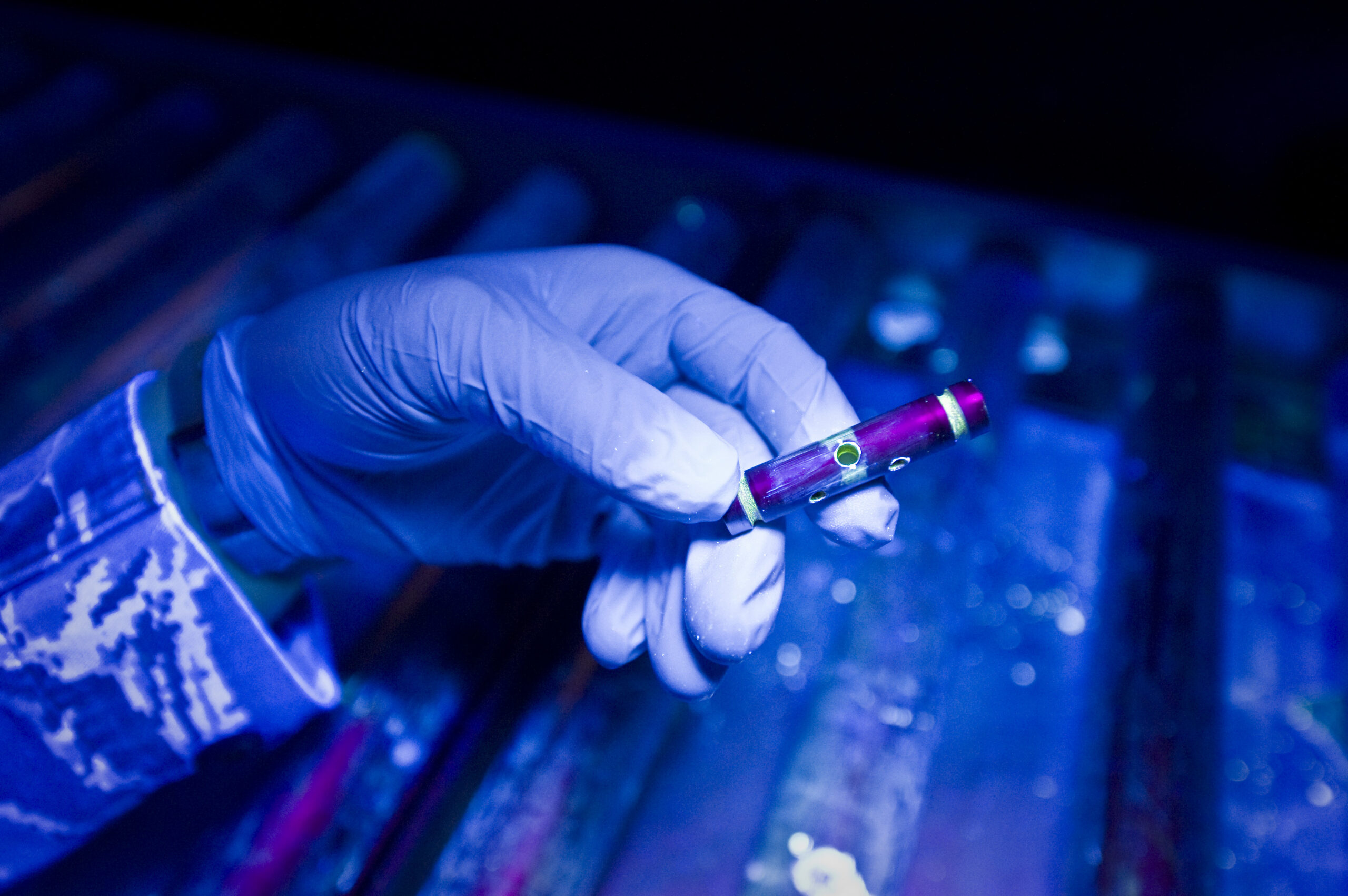
Staff Sgt. David Bayle inspects an aircraft pin for cracks under a black light after dipping the part into chemicals mixed to show cracks not normally visible to the naked eye at the 379th Air Expeditionary Wing in Southwest Asia, Aug. 6, 2013. Bayle is a 379th Expeditionary Maintenance Squadron nondestructive inspection craftsman deployed from Eielson Air Force Base, Alaska, and hails from Port Sanilac, Mich. (U.S. Air Force photo/Senior Airman Benjamin Stratton)
Composites in Space: Reusability Changes the Inspection Paradigm
The broader push toward reusable launch vehicles — exemplified not only by MT Aerospace’s landing leg work but also by programs like the ENVOL small satellite launcher and Toray’s composite upper stage tank development — is fundamentally reshaping how the space industry thinks about composite structures.
When a composite structure is designed for a single use, inspection focuses on manufacturing quality and initial structural integrity. When that same structure is designed for reuse across multiple flights, the inspection paradigm expands dramatically. Now you need methods for assessing accumulated damage, monitoring material degradation over thermal cycles, detecting barely visible impact damage from landing events, and making accept/reject decisions that account for the structure’s remaining useful life.
Embraer’s composite wing testing for the PDNT technology demonstrator — where the structure withstood progressive loads exceeding 200% of the expected limit — demonstrates the kind of structural validation testing that must be complemented by ongoing NDT throughout the component’s service life.
What this means for NDT: Reusable composite space structures will drive demand for portable, field-deployable NDT solutions that can be used at launch and landing sites — not just in clean room manufacturing environments. Laser shearography, with its ability to rapidly assess large areas for impact damage and disbonds without contact or couplants, is particularly well-suited to this application. Photothermal tomography, such as the Voidsy systems we work with at CICNDT, offers another powerful non-contact approach for rapid surface and near-surface defect assessment.
The space industry’s embrace of composites for reusable structures will ultimately require NDT programs that span the entire lifecycle — from manufacturing through multiple service cycles to retirement — creating digital inspection records that feed into structural health management systems.
Crashworthiness Testing: Where NDT Meets Structural Simulation
Dr. Mostafa Rassaian and Dr. Dan Adams’s continuing series on crashworthiness testing of composites using the building block approach provides a comprehensive framework for how composite structures are validated for crash performance. Their work with the CMH-17 Crashworthiness Working Group demonstrates that as composite crash structures become more complex — moving from simple coupons to full-barrel fuselage sections — the failure modes multiply and interact in ways that only sophisticated numerical analysis can predict.
At each level of the building block pyramid, physical testing validates analytical models. Eleven different progressive damage and failure analysis methods were assessed against experimental C-channel crush test data. The correlation between simulation and test results determines whether a design can be certified by analysis rather than requiring exhaustive testing at every scale.
What this means for NDT: Crashworthiness testing is not traditionally thought of as an NDT application, but it should be. The ability to non-destructively characterize the internal state of a composite structure before, during, and after crush testing — using CT scanning, digital image correlation, and other techniques — provides the data needed to validate and refine the analytical models that drive certification.
At the AIMM Center, our robotic CT system can provide the detailed volumetric characterization of damage initiation and propagation that is essential for calibrating progressive damage analysis methods. When MT Aerospace used the Aramis 3D digital image correlation system to track displacements during their landing leg deployment tests, they were using exactly the kind of full-field measurement approach that complements our CT-based internal characterization.
Building the Inspection Ecosystem
One theme that emerges clearly from all of these industry developments is the need for an interconnected inspection ecosystem — one that brings together multiple NDT techniques, applied in the right sequence, at the right stage of the manufacturing and service lifecycle.
Spiral RTC’s co-founder Hans Luinge put it well when describing the challenge of scaling recycled composites: the technology is ready, but the collaborative ecosystem needed to make it work at industry scale is still being built. The same is true for NDT. Individual techniques — CT, phased array ultrasonics, laser shearography, photothermal tomography — are each powerful in their own right. But their real value emerges when they are integrated into a comprehensive inspection program that matches the right technique to the right application at the right time.
This is the core philosophy behind CICNDT and the AIMM Center’s approach:
- Laser shearography for rapid, full-field screening of large composite structures — aircraft skins, wind turbine blades, rocket fairings — identifying areas that require further investigation.
- Phased array ultrasonics for detailed, production-rate inspection of specific features and known defect types — delaminations, porosity, disbonds — with the resolution and coverage needed for accept/reject decisions.
- Robotic CT scanning through the AIMM Center’s Scan as a Service capability for the deepest level of analysis — process development, first article inspection, failure analysis, and the characterization of novel materials and manufacturing processes.
- Photothermal tomography via our partnership with Voidsy for non-contact, large-area surface and near-surface assessment that bridges the gap between rapid screening and detailed volumetric analysis.
As the composites industry continues to evolve — embracing recycled materials, automated manufacturing, reusable structures, and novel applications — the demand for sophisticated, multi-technique inspection programs will only grow. At CICNDT, we are building that capability today.
Looking Ahead
The articles and developments discussed here represent just a snapshot of a rapidly moving industry. McLaren’s automated rapid tape (ART) method for high-rate automotive composites, Fibionic’s bionic fiber placement technology, Reliance Industries’ planned carbon fiber production launch in India, Caracol’s large-format additive manufacturing for marine composites, Adaptix’s mobile 3D X-ray imaging for composite inspection — each of these points to a future where composite structures are more numerous, more varied, and more demanding than ever before.
For NDT professionals and the manufacturers they serve, the message is clear: staying ahead requires investing not just in inspection hardware, but in the expertise, procedures, and integrated workflows that turn raw inspection data into actionable engineering decisions.
At CICNDT and the AIMM Center, that is exactly what we do. Whether you are qualifying a recycled thermoplastic material for a new application, validating an AFP-produced aerospace structure, or developing inspection procedures for a reusable space vehicle component, we have the technology, the expertise, and the collaborative approach to help you get there.
To learn more about CICNDT’s inspection services and the AIMM Center’s Scan as a Service capabilities, contact us at CICNDT.com.
Sources: CompositesWorld, May 2025 and August 2025 issues. All technical claims and quotations referenced from published articles.