
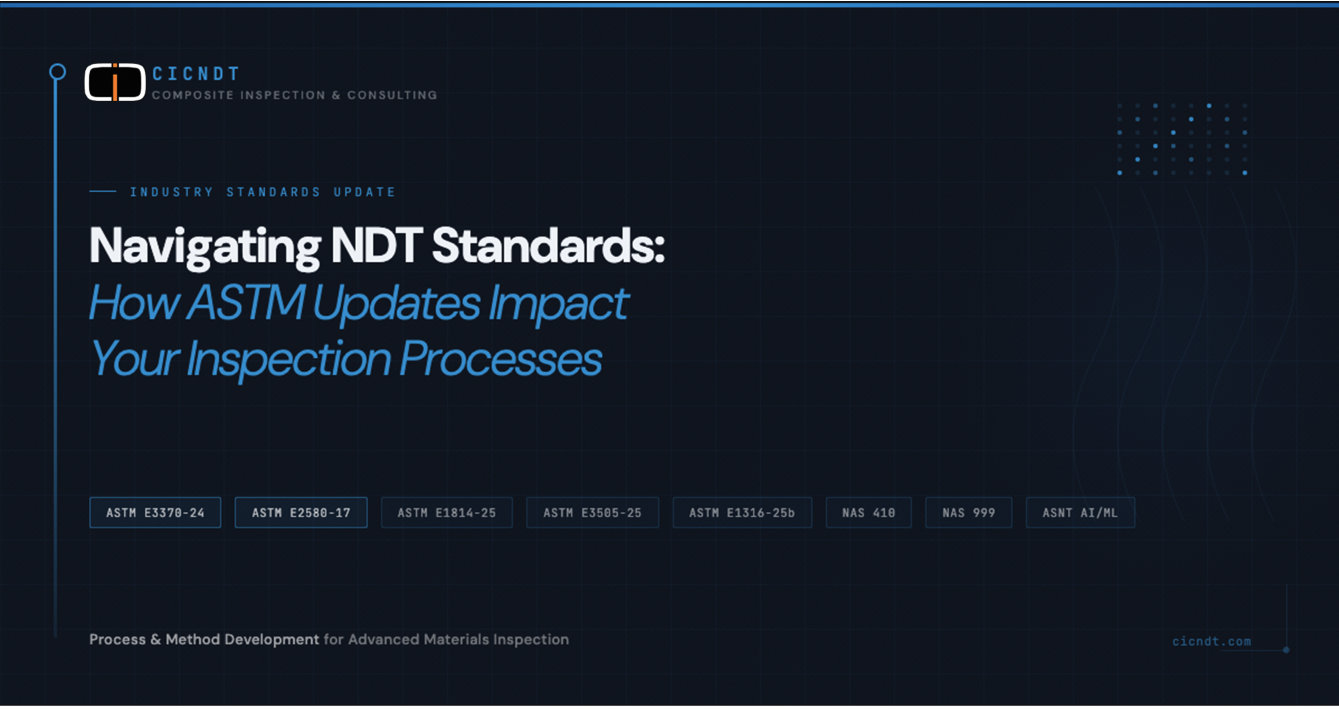
Recent ASTM and ASNT standards revisions directly affect how composite and advanced material inspection procedures are developed, validated, and maintained. CICNDT breaks down what matters for your operations.
Navigating NDT Standards: How ASTM Updates Impact Your Inspection Processes
Standards don’t just define what you inspect — they define how you build the process to inspect it. For organizations that develop custom inspection methods for advanced materials, every ASTM revision has the potential to change procedure parameters, acceptance criteria, and qualification requirements that directly affect the work you deliver.
At Composite Inspection and Consulting (CICNDT), standards compliance isn’t a checkbox. It’s the foundation of every inspection process and method we develop. Here’s what you need to know about the current standards landscape and what recent changes mean for your operations.
The Standards Ecosystem: More Than One Organization
Understanding NDT standards starts with understanding who publishes what — and how the pieces fit together.
ASTM International publishes the technical standards that describe how to perform NDT methods. Over 180 NDT standards live in ASTM Volume 03.03, covering everything from ultrasonic testing procedures to computed tomography practices. These are the documents that drive inspection procedure development.
ASNT publishes personnel qualification and certification standards — SNT-TC-1A, CP-189, and the ANSI/ASNT CP-9712 adoption of ISO 9712. These define who is qualified to execute those procedures. NAS 410, harmonized with EN 4179, governs personnel certification specifically for aerospace manufacturing and MRO.
Then there are the codes — ASME BPVC, for example — that invoke ASTM standards and make them contractually binding for specific applications.
The practical implication: when ASTM updates a standard practice for ultrasonic testing of composites, the ripple effects can touch your written procedures, your personnel training requirements, and your contractual obligations simultaneously.
Recent ASTM Updates That Matter for Composite Inspection
Several recent revisions and new standards directly impact how composite and advanced material inspections are developed and executed.
ASTM E3370-24: Matrix Array Ultrasonic Testing of Composites, Sandwich Core Constructions, and Metals. This is a significant addition to the composite inspection landscape. E3370-24 establishes procedures for matrix array UT — both pulse echo and through transmission — covering monolithic composites, sandwich constructions, and metals. The standard addresses detection of interply delaminations, foreign object debris, inclusions, disbonds, porosity, impact damage, and thickness variations. For method developers, this standard formalizes what has been emerging practice and gives a codified framework for building MAUT procedures.
ASTM E2580-17: Ultrasonic Testing of Flat Panel Composites and Sandwich Core Materials. Still the workhorse standard for conventional UT of flat panel composites in aerospace. If your procedures reference E2580, you need to confirm your current revision is active and that your process documentation reflects any updated requirements for pulse echo and through transmission techniques across the 0.5 to 20 MHz range.
ASTM E1814-25: Computed Tomographic (CT) Examination of Castings. The 2025 revision updates CT practices — relevant for organizations using CT as part of a multi-method inspection approach, particularly where composite-to-metal interfaces or hybrid structures are involved.
ASTM E3505-25: Direct Determination of CT Detail Detection Sensitivity. A new practice for calculating numerical detection limits in computed tomography. If you’re developing CT-based inspection methods, this standard provides a quantitative framework for validating your process sensitivity.
ASTM E1316-25b: Standard Terminology for Nondestructive Examinations. Updated terminology may seem administrative, but when your procedures reference ASTM-defined terms, a terminology change can trigger a procedure revision. This is especially relevant for organizations maintaining ISO 17025 or NAS 410 compliance, where terminology consistency between procedures and standards is auditable.
What’s Coming: The ASNT AI/ML Standard
ASNT’s proposed standard on the use of AI/ML for NDT/E applications completed its public review period in mid-2025 and is currently under consideration by the ASNT Standards Council. This standard establishes minimum requirements for developing, validating, deploying, and maintaining AI/ML tools in the NDT field.
For method developers, this is a significant development. The standard addresses data management, data preparation, model validation, and performance metrics — including sensitivity (probability of detection) and specificity (false call rate). It signals that AI-assisted inspection isn’t a future consideration; it’s an active standards conversation happening now.
Organizations that are already integrating automated data analysis or pattern recognition into their inspection workflows should be tracking this standard closely. The validation frameworks it establishes will likely become the benchmark for demonstrating that AI-augmented inspection processes meet the same reliability thresholds as conventional methods.
How Standards Updates Affect Your Inspection Process Development
When ASTM revises a standard, the impact extends well beyond downloading the new document. Here’s what a revision cycle typically triggers in a well-managed inspection operation:
Procedure Review and Gap Analysis. Every written procedure that references the updated standard needs to be reviewed against the new requirements. Changes to calibration methods, reference standard specifications, scanning parameters, or acceptance criteria all require documented procedure updates.
Reference Standard and Equipment Validation. New or revised standards may change requirements for reference standards — the physical artifacts used to calibrate and validate your inspection setup. If E3370-24 specifies different reference flaw configurations than your current standards, you need new reference panels before you can qualify procedures under the updated standard.
Personnel Requalification. When procedure parameters change, technicians who were qualified under the previous version may need retraining and requalification. This is particularly true under NAS 410 and CP-189 frameworks, where personnel qualifications are tied to specific written procedures.
Client Communication. If you’re performing inspections under contract, your clients need to know when the standards their specifications invoke have been updated. A proactive notification — with a summary of what changed and how it affects their inspection requirements — distinguishes a technical partner from a service vendor.
CICNDT’s Approach: Process and Method Development First
At CICNDT, we don’t just perform inspections to standards — we develop the inspection processes and methods that make standards-compliant inspections repeatable and defensible.
That means we track ASTM revision cycles as part of our method development workflow. When a standard is updated, we evaluate the impact on our existing procedure library, identify gaps, and update our processes before the revision creates a compliance issue for our clients.
For composite structures and advanced materials, this is especially critical. Standards like NAS 999, E2580, and the new E3370-24 define the framework, but the actual inspection process — transducer selection, scan plan design, gate and threshold optimization, reference standard fabrication, and acceptance criteria interpretation — is where the method development expertise lives.
Standards tell you what to do. Process and method development determines whether you can do it reliably, every time, on the specific material and geometry in front of you.
Staying Current Without Getting Buried
For small and mid-size NDT operations, keeping up with standards revisions can feel overwhelming. A few practical recommendations:
Track ASTM Volume 03.03 and the E07 Committee activity for NDT-specific updates. Subscribe to revision alerts for the standards your procedures reference directly.
Maintain a standards matrix that maps each of your written procedures to the specific ASTM, ASNT, NAS, and ASME documents they invoke. When a revision drops, you can immediately identify which procedures are affected.
Build standards review into your quality management system — not as an annual audit item, but as a triggered process whenever a referenced standard is revised.
Engage with the standards development process. ASTM committees accept new members, and participating in ballot reviews gives you advance visibility into changes before they’re published.
CICNDT specializes in inspection process and method development for composite and advanced material structures across aerospace, defense, and energy sectors. We develop custom inspection procedures that meet current standards requirements while solving the technical challenges that off-the-shelf approaches can’t address. Contact us to discuss how recent standards updates affect your inspection operations.