
Understanding Non-Destructive Testing Techniques
When it comes to ensuring the safety and reliability of materials and structures, Non-Destructive Testing (NDT) is an invaluable practice. This article will guide you through the various NDT methods, explaining what NDT means, its importance, and how it differs from destructive testing. We’ll also delve into the training and certification required for NDT professionals.
Non-Destructive Testing, often abbreviated as NDT, is a collection of techniques used to evaluate the properties of a material, component, or system without causing damage. This testing is crucial in industries like aerospace, construction, and manufacturing, where the integrity of a material is paramount.
NDT encompasses a wide range of analytical techniques used to determine the integrity of materials. Unlike other testing methods, NDT does not impair the material’s future usability. Its scope spans across various industries, making it a versatile and indispensable tool in quality assurance and maintenance.
The history of NDT dates back to the early 20th century, with technological advancements paving the way for more sophisticated methods. Initially used in the railroad industry, NDT techniques have evolved significantly, integrating digital technologies and advanced imaging techniques to improve accuracy and efficiency.
The primary advantage of NDT is that it allows for the inspection of materials without altering or destroying them, ensuring they can still be used after testing. This sets it apart from destructive testing, where the material is damaged or destroyed to assess its properties. NDT is particularly advantageous in situations where the preservation of the test subject is critical.
NDT is employed across multiple sectors, including aerospace, automotive, and civil engineering. Each industry utilizes specific NDT methods tailored to its unique requirements. For instance, the aerospace industry relies heavily on ultrasonic testing to ensure the integrity of aircraft components, while the construction industry may use visual inspection for structural assessments.
NDT plays a vital role in quality control, safety, and reliability. By using these techniques, industries can detect defects and irregularities in materials and structures early, preventing failures that could lead to costly repairs or catastrophic accidents. Furthermore, regular nondestructive inspections can extend the life of equipment and structures, saving money and resources in the long run.
One of the most critical roles of NDT is ensuring the safety of infrastructures and components. By identifying potential defects early, NDT helps to prevent failures that could result in accidents or injuries. Moreover, NDT is essential for compliance with industry standards and regulations, which mandate regular inspections to maintain operational safety.
NDT offers significant cost savings by enabling early detection of defects, thus avoiding expensive repairs or replacements. By ensuring that materials and structures are sound, businesses can avoid costly downtime and maintain operational efficiency. Additionally, NDT methods are generally quicker and less labor-intensive than destructive testing.
In addition to safety and cost savings, NDT improves the overall quality of products. By detecting defects before products reach the market, manufacturers can uphold high-quality standards, which enhances customer satisfaction and brand reputation. NDT techniques ensure that only materials meeting stringent quality criteria are used in production.
NDT contributes to environmental sustainability by minimizing material wastage. As it does not damage the materials being tested, NDT helps in conserving resources and reducing the environmental footprint of manufacturing processes. This aspect is increasingly important as industries strive to adopt more eco-friendly practices.
There are several NDT methods, each suitable for different applications. Here are some of the most commonly used techniques:
Visual Inspection is the simplest form of NDT, involving the careful visual examination of a material or structure. It often uses tools like magnifying glasses, mirrors, and borescopes for areas that are difficult to view directly.
The core of visual inspection lies in the human eye’s ability to detect anomalies. Inspectors use visual cues to identify surface defects such as cracks, corrosion, and misalignments. This method is often the first line of defense in detecting visible defects.
While the human eye is the primary tool, various instruments enhance the inspection process. Tools such as borescopes allow inspectors to view areas that are otherwise inaccessible. Additionally, advanced imaging technologies, such as digital cameras, provide detailed documentation of findings.
Visual inspection is widely used across industries due to its simplicity and cost-effectiveness. In the construction industry, it serves as a preliminary check for structural integrity. In manufacturing, it ensures that components meet visual quality standards before assembly.
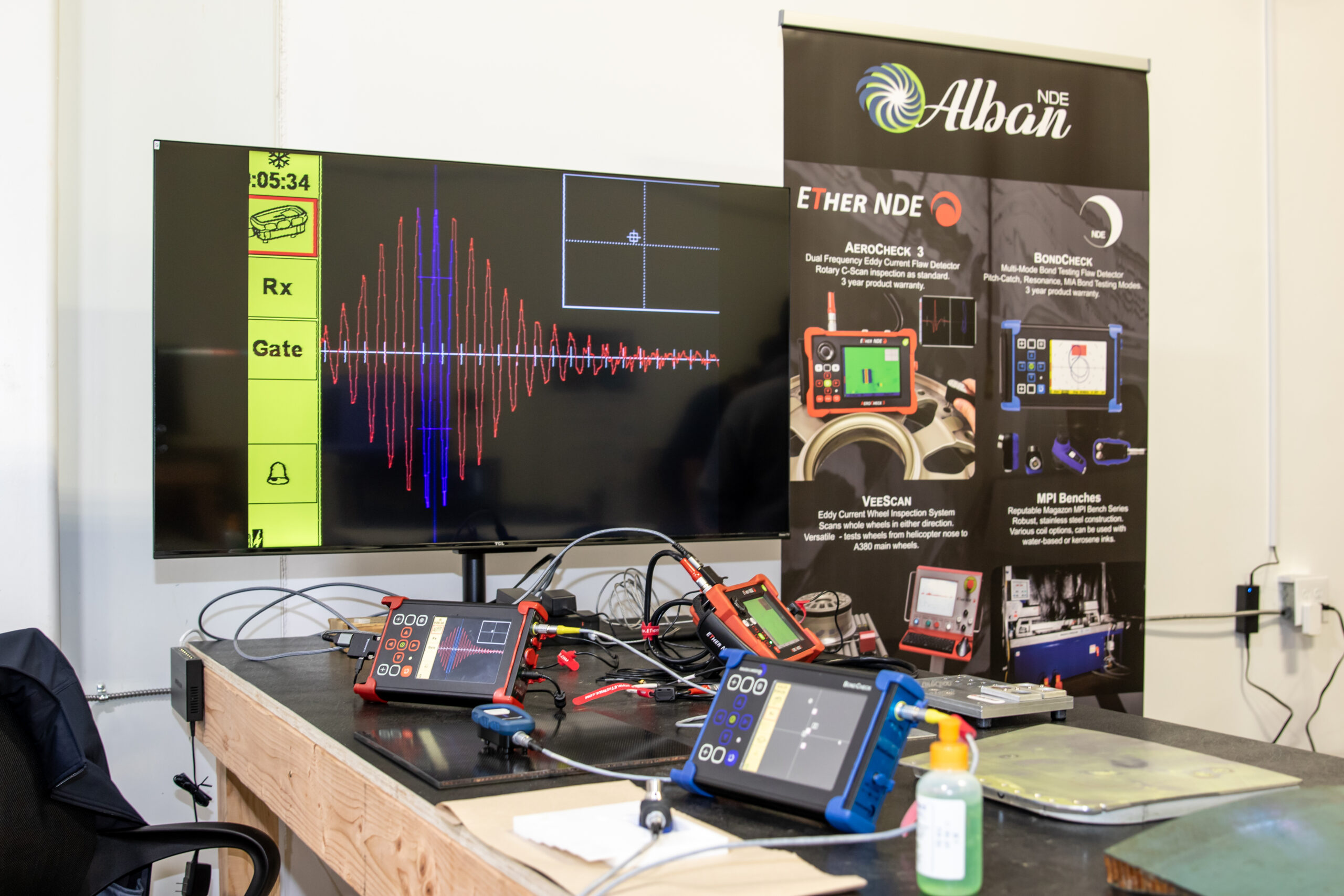
Alban NDT equipment in use by CICNDT NDT system setup for advanced inspection, data acquisition, and defect detection demonstrations.
Ultrasonic Testing uses high-frequency sound waves to detect internal flaws or characterize materials. A transducer sends sound waves into the material, and any reflected waves are analyzed to identify defects such as cracks or voids.
Working Mechanism of Ultrasonic Testing
Ultrasonic testing operates on the principle of sound wave reflection. When sound waves encounter a flaw, such as a crack, they are reflected back to the transducer. The time it takes for the waves to return helps in identifying the location and size of the defect.
Types of Ultrasonic Testing
There are several types of ultrasonic testing, including pulse-echo and through-transmission methods. Pulse-echo is the most common, where waves are sent and received by the same transducer. Through-transmission involves two transducers, with one sending and the other receiving the sound waves.
Advantages and Limitations
Ultrasonic testing is highly sensitive and can detect minute defects deep within materials. However, it requires skilled operators and may be less effective on materials with complex geometries. Despite these limitations, it remains a preferred choice for inspecting welds and composites.
3. Radiographic Testing (RT)
Radiographic Testing involves using X-rays or gamma rays to create images of the internal structure of a material. This technique is similar to medical X-rays and is effective at identifying internal defects without damaging the material.
Process and Equipment Used
Radiographic testing involves directing radiation through a material and capturing the resultant image on a film or digital detector. The density of the material affects the radiation absorption, highlighting internal features and defects in the captured image.
Film vs. Digital Radiography
Traditional radiography uses film to capture images, which is then developed in a darkroom. Digital radiography, on the other hand, uses digital detectors, offering faster processing and the ability to enhance images for better analysis. The choice between the two depends on specific testing requirements and cost considerations.
Safety Considerations
Radiographic testing involves exposure to radiation, necessitating strict safety protocols. Operators must be trained in radiation safety and use protective equipment to minimize exposure. Additionally, regulatory standards govern the permissible levels of radiation, ensuring safe practice.
4. Magnetic Particle Testing (MT)
Magnetic Particle Testing is used to detect surface and near-surface defects in ferromagnetic materials. The process involves magnetizing the material and applying ferrous particles. Any disturbances in the magnetic field, caused by defects, attract the particles, making them visible.
Principles of Magnetism in Testing
The principle of magnetic particle testing relies on the fact that defects in a material cause local magnetic field distortions. By applying ferrous particles, these distortions become visible as the particles accumulate at defect sites, providing a clear indication of their presence.
Techniques and Equipment
Techniques vary from dry particle inspection, where dry powder is used, to wet particle inspection, involving a liquid carrier fluid. Equipment includes electromagnets or permanent magnets for magnetization, with the choice depending on the material and defect type.
Industry Applications
This method is predominantly used in the automotive and aerospace industries for inspecting components like engine parts and landing gear. It is also vital in the rail industry for checking tracks and wheels, ensuring safety and reliability.
5. Dye Penetrant Testing (PT)
Dye Penetrant Testing involves applying a liquid dye to the surface of a non-porous material. After a set time, excess dye is removed, and a developer is applied. The developer draws out any dye trapped in surface-breaking defects, making them visible.
Steps in Dye Penetrant Testing
The process begins with surface cleaning to remove contaminants that might obscure defects. After applying the dye, a dwell time allows it to seep into any surface defects. Post removal of excess dye, a developer highlights the defect areas by pulling the trapped dye to the surface.
Types of Dye Penetrants
Dyes can be visible or fluorescent, with the latter requiring ultraviolet light to view. Fluorescent dyes are preferred for detecting fine defects due to their enhanced visibility under UV light, while visible dyes are used for general applications.
Benefits and Limitations
Dye penetrant testing is cost-effective and simple, making it accessible for small workshops and large industries alike. However, it is limited to detecting surface defects only and requires careful surface preparation to avoid false indications.
6. Eddy Current Testing (ECT)
Eddy Current Testing uses electromagnetic induction to detect flaws in conductive materials. A probe induces an eddy current in the material, and any disruptions caused by defects alter the current flow, which is then analyzed.
Principles of Electromagnetic Induction
Eddy current testing relies on electromagnetic induction to detect defects. When a probe generates an alternating magnetic field, it induces eddy currents in the conductive material. Defects disrupt these currents, which are detected by changes in the probe’s impedance.
Instrumentation and Techniques
Instrumentation includes portable eddy current testing devices and probes of various shapes and sizes, tailored to specific applications. Techniques range from pencil probes for small areas to array probes for larger surfaces, offering versatility in inspection.
Applications and Advantages
This method is widely used in the aerospace industry for inspecting aircraft fuselage and wing surfaces. It is non-contact, allowing for rapid inspections. Eddy current testing is particularly advantageous for detecting surface and near-surface defects without requiring extensive preparation.
NDT Training and Certification
To perform NDT effectively, technicians must be properly trained and certified. Various nondestructive testing schools offer training programs that cover different NDT methods. Upon completion of training, technicians can pursue certification, demonstrating their competence in specific NDT techniques.
Importance of Professional Training
Professional training ensures that technicians are equipped with the necessary skills to conduct NDT accurately. It covers theoretical knowledge and practical applications, emphasizing safety protocols and the interpretation of results. Proper training is crucial for maintaining industry standards and ensuring reliable inspections.
Levels of NDT Certification
NDT certifications are typically divided into three levels:
- Level I: Technicians can perform specific calibrations and tests under supervision. They are trained to follow instructions and report results accurately.
- Level II: Technicians can set up and calibrate equipment, conduct tests, and interpret results independently. They are capable of performing a wide range of inspections and ensuring compliance with procedures.
- Level III: Technicians have advanced expertise and can develop procedures, interpret codes, and train and certify other technicians. They play a key role in quality assurance and the development of NDT programs.
Certification Bodies and Standards
Several organizations offer NDT certification, including the American Society for Nondestructive Testing (ASNT) and the International Organization for Standardization (ISO). These bodies establish the standards and guidelines for certification, ensuring a uniform level of competence across the industry.
NDT vs. Destructive Testing
It’s important to understand the difference between NDT and destructive testing. While NDT assesses materials without causing harm, destructive testing involves testing the material to its failure point to understand its properties. Destructive testing is often used for research and development, while NDT is preferred for routine inspections and quality assurance.
Comparative Analysis of Testing Methods
NDT offers several advantages over destructive testing, including non-invasiveness and cost-effectiveness. However, destructive testing provides detailed insights into material properties, which is invaluable for research and development. The choice between the two depends on the objectives and constraints of the testing scenario.
Scenarios for Destructive Testing
Destructive testing is typically used in scenarios where understanding the ultimate strength and failure modes of a material is critical. It is common in the development of new materials and products, where failure data can inform design improvements and material selection.
Integration of Both Methods
In many cases, NDT and destructive testing are used in tandem to provide a comprehensive assessment of material properties. NDT is employed for ongoing inspections and quality control, while destructive testing is reserved for specific research objectives or when materials are no longer required.
The Future of NDT
With advancements in technology, NDT methods continue to evolve. Innovations such as digital radiography and automated ultrasonic testing offer more precise and faster inspections. Additionally, the integration of artificial intelligence and machine learning in NDT promises to enhance defect detection and analysis capabilities.
Technological Innovations
The incorporation of technologies like AI and machine learning in NDT is transforming the field. These technologies enhance data analysis, allowing for more accurate and reliable defect detection. Automated systems also reduce human error and improve inspection efficiency.
Digital Transformation
Digital technologies are revolutionizing NDT, with digital radiography and automated data collection systems leading the way. These advancements allow for real-time data analysis and remote inspections, offering greater flexibility and efficiency in conducting tests.
Challenges and Opportunities
While technological advancements present significant opportunities, they also pose challenges, such as the need for skilled personnel to operate and maintain advanced systems. Continuous training and adaptation to new technologies are crucial to fully leverage the potential of modern NDT methods.
Conclusion
Non-Destructive Testing is a crucial aspect of maintaining the safety and reliability of materials and structures across various industries. By understanding the different NDT methods and their applications, businesses can ensure the integrity of their products while saving time and resources. Proper training and certification of NDT technicians further enhance the effectiveness of these methods, ensuring high standards of quality and safety.
The Role of NDT in Industry
As technology advances, so too will the capabilities of NDT, making it an indispensable tool in the pursuit of excellence in manufacturing, construction, and beyond. The role of NDT in industry is set to expand, driven by the growing demand for high-quality, safe, and reliable products.
Future Prospects
The future of NDT is bright, with ongoing research and development promising even more sophisticated methods. As industries continue to innovate, NDT will remain at the forefront, ensuring that materials and structures meet the highest standards of quality and safety.
Final Thoughts
In conclusion, NDT is more than just a testing method; it is a critical component of modern industry, ensuring the safety, reliability, and efficiency of countless products and structures. As we move forward, the continued evolution of NDT will play a vital role in shaping the future of industries worldwide.