
Four systems, one platform: how to match voidsy’s photothermal tomography lineup to your composite parts, your inspection environment and your budget.
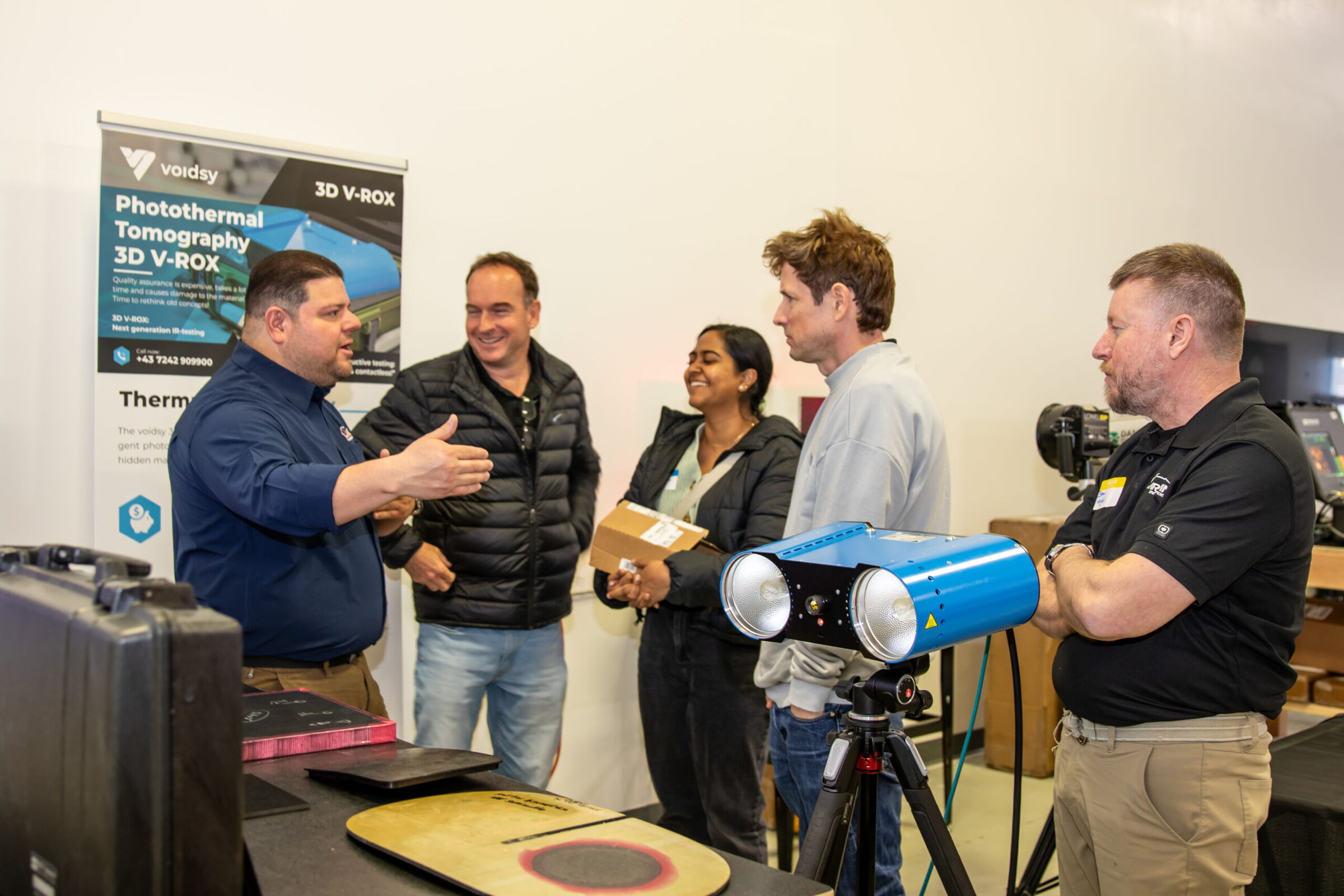
CICNDT demonstrates voidsy photothermal tomography at the AIMM Center in Ogden, Utah.
When CICNDT began working with voidsy in 2024, photothermal tomography was still a new idea for most inspection teams. Two years later, the question we hear most is no longer “what is it?” but “which system do we need?”
voidsy now offers a family of four systems, the V-ROX, V-ROX plus, 3D V-ROX and 3D V-ROX plus, all built on the same active thermography platform. This guide explains how the technology works, what separates each model, and where photothermal tomography fits alongside the ultrasonic, shearography and CT methods already in your toolbox.
How Photothermal Tomography Works
Photothermal tomography is a form of active thermography. Instead of passively watching a part, the system briefly heats the surface with a controlled energy pulse and records how that heat moves into the material with a high-speed infrared camera.
In sound material, heat diffuses evenly. A delamination, void, porosity cluster, inclusion or impact damage disrupts that flow and leaves a distinct thermal signature on the surface. Where conventional thermography stops at a 2D “hot spot” image, voidsy’s software applies reconstruction algorithms that turn the noisy thermal data into a precise picture of internal structure, including, on the 3D models, how deep the defect sits.
For inspection teams, that means:
- No contact and no couplant: nothing touches the part, and there is no water or gel to clean up.
- Large areas per shot: the 3D V-ROX plus covers an inspection area of up to 400 mm × 320 mm at a time.
- Defect sizing: voidsy reports that its systems determine absolute defect sizes without the need for a secondary method.
- Portable: the sensor heads are compact enough for shop floor, hangar and field use.
The V-ROX Family at a Glance
All four systems share the same core technology. The differences come down to two questions: do you need 2D or 3D results, and do you need built-in operator assistance for guided, repeatable work in the field?
| System | Results | Operator assistance | Best fit |
|---|---|---|---|
| V-ROX | 2D | No | Entry-level screening and production checks |
| V-ROX plus | 2D | Yes | Assisted inspection in the field |
| 3D V-ROX | 3D with depth | No | Detailed defect analysis in the lab or cell |
| 3D V-ROX plus | 3D with depth | Yes | Maximum information in demanding field and industrial work |
V-ROX: Entry-level 2D inspection
The V-ROX is voidsy’s entry point into active thermography. It produces 2D images of hidden defects and suits teams that need fast, non-contact screening, such as checking for porosity or disbonds on production parts, without full depth analysis.
V-ROX plus: Assisted 2D inspection for the field
The “plus” models add operator assistance systems. On the 3D V-ROX plus these include an ergonomic handle, an RGB camera, a cross-hair positioning laser and laser distance measurement. Together they help technicians position the sensor consistently and document exactly where each measurement was taken, which matters when you are working on a wing, blade or hull rather than a fixture.
3D V-ROX: Depth-resolved defect analysis
The 3D V-ROX adds photothermal tomography’s 3D reconstruction, giving a spatial view of defect structure and depth. This is the system that earned voidsy the inVISION Top Innovation 2024 award, and it is the model CICNDT trained on with voidsy’s engineers in Wels, Austria. It is well suited to impact damage in carbon fiber reinforced polymer (CFRP), where knowing which ply a delamination sits in drives the repair decision.
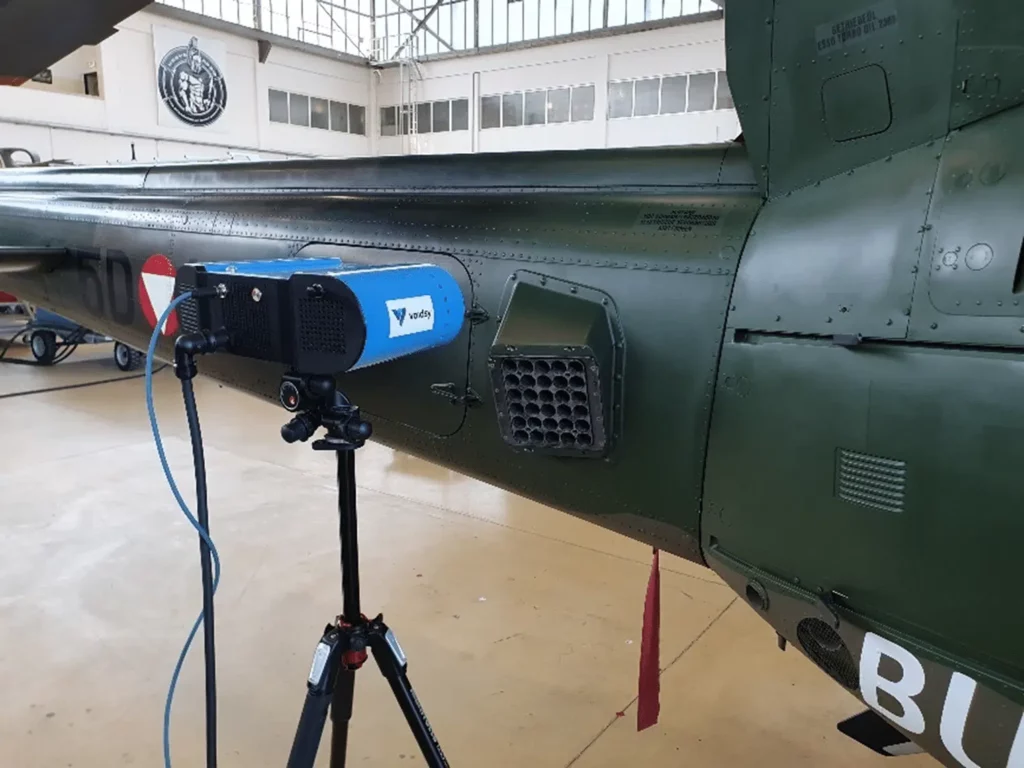
A voidsy V-ROX system inspecting a helicopter tail boom.
3D V-ROX plus: 3D analysis with full assistance
The top of the range combines 3D reconstruction with the full set of assistance systems. voidsy lists a spatial and depth resolution of up to 610 µm and 100 µm, an inspection area of up to 400 mm × 320 mm, and a compact sensor head of 423 × 270 × 130 mm weighing less than 6.5 kg. It pairs with voidsy Inspect Professional, the full-featured version of voidsy’s analysis software.
voidsy Inspect: The Software Behind the Images
Every V-ROX system runs on voidsy Inspect, a modular platform for 2D visualization, 3D reconstruction, guided inspection workflows and reporting. Because the hardware platform is shared, teams can start with 2D inspection and move toward 3D analysis as their programs grow, without relearning a new interface.
Where Photothermal Tomography Fits in Your NDT Program
Photothermal tomography is not a replacement for every method. It is a fast, contactless complement that is strongest where other methods are slow or awkward:
- Versus ultrasonic testing: no couplant and no contact, and a large area per measurement. UT remains the benchmark for deep flaws in thick laminates.
- Versus laser shearography: both are full-field and non-contact. Shearography excels at disbonds under load; photothermal tomography adds depth information and defect sizing.
- Versus CT: CT delivers the most complete volumetric picture but requires the part to go to the scanner. A V-ROX goes to the part.
Like all thermal methods, photothermal tomography performs best on defects nearer the surface, so very deep flaws in thick sections may still call for ultrasonics or CT. At the AIMM Center, we routinely combine methods to find the best answer for each part.
Proven Applications
- Aerospace: voidsy has demonstrated 3D inspection of thermoplastic preforms made from PEEK sheets and UD tapes overmoulded with PEEK, an increasingly important material family for next-generation airframes. Read more in our article on thermoplastic composites inspection.
- Impact damage in CFRP: 3D visualization of delaminations after impact, a common inspection task for aircraft structures.
- Wind energy: rotor blade inspection for porosity, inclusions and bond-line defects.
- Automotive: composite body and structural components where cycle time matters.
voidsy states that its technology can be up to 80% faster than current standard inspection methods and deliver up to 70% cost savings. Results depend on the part and application, and a trial on your own components is the best way to find out what it means for your line.
Why Buy Through CICNDT
CICNDT has worked with voidsy since 2024. Our CEO Jeremy Heinks and Senior Principal NDT Level 3 Specialist Oscar Balandran trained on the 3D V-ROX with voidsy’s engineers in Austria, and we demonstrate it at the AIMM Center in Ogden, Utah. When you work with us, you get:
- Application trials on your own parts before you buy.
- Help choosing the right model for your parts and environment, from V-ROX to 3D V-ROX plus.
- Level 3 technique development and procedure writing.
- Operator training for your technicians.
- Scan-as-a-service if you want results before you invest in equipment.
See It on Your Parts
The fastest way to know whether photothermal tomography fits your application is to see it on your own components. Contact CICNDT to schedule a demo at the AIMM Center, or visit our Sales page to explore the full voidsy lineup alongside our other partner solutions.
Product details in this article are based on information published by voidsy gmbh as of September 2026 and may change.